
Introduction to Accuracy vs Precision
Accuracy vs Precision Knowing the difference between them is vital in mathematics, science, the engineering field, analysis of data and everyday decision-making. The two terms are frequently misunderstood; however, they refer to various aspects of measuring quality.
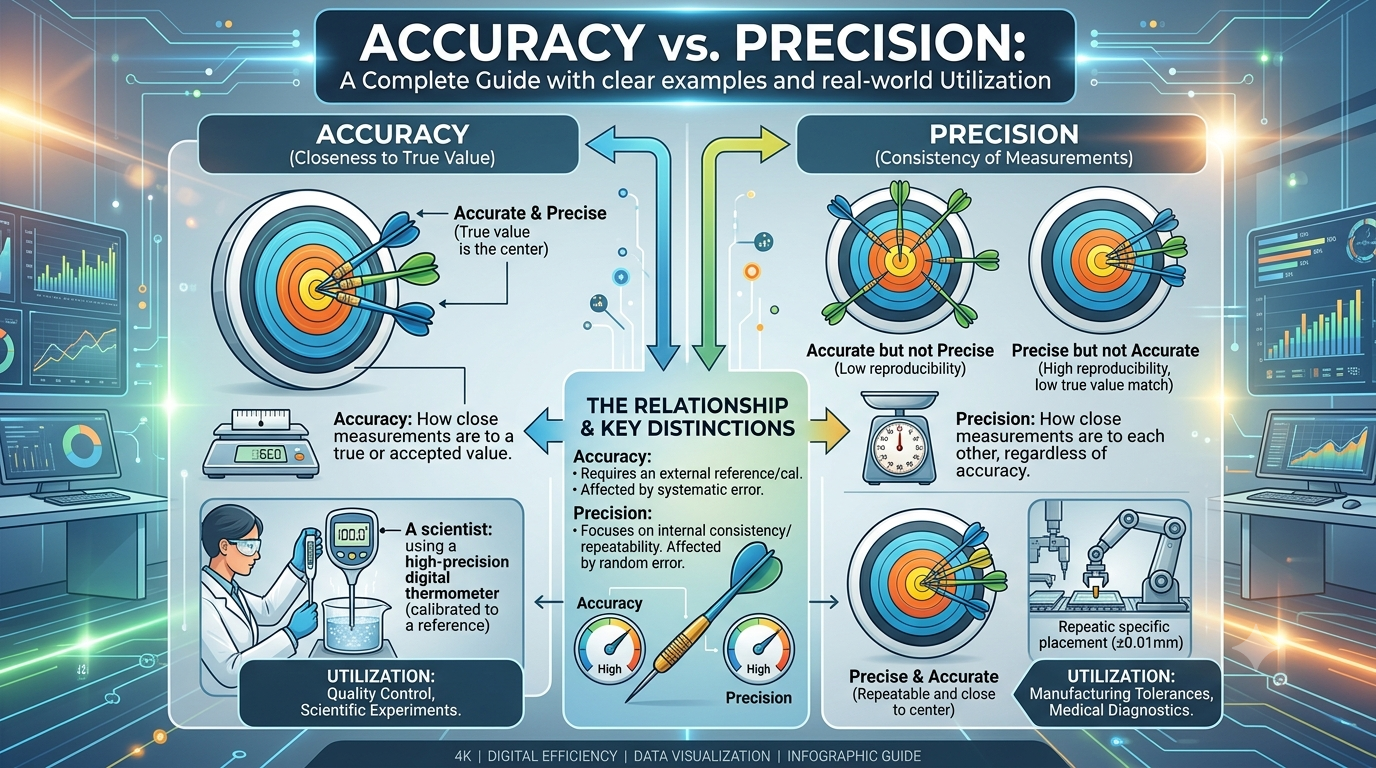
In simple terms, accuracy shows the exactness of a number to the actual or correct value, while precision indicates how reliable repeated measurements are. Many people think they’re identical; however, precision and accuracy are two distinct concepts.
Through this post, you’ll be able to understand the significance and distinctions of the two, as well as examples and uses of precision vs. accuracy in a straightforward and user-friendly manner.
What Is Accuracy
‘Accuracy’ refers to the degree of accuracy of an estimate compared to the actual value or the accepted value. If your measurement is near to the actual value, then it is accurate.
For instance:
If the temperature you are measuring is 25°C and your thermometer displays 25.1°C It is correct.
If you take a measurement and find 99.8 millimetres instead of 100 metres, it’s also accurate.
Accuracy and Precision | Physics | Research Starters
In scientific research and physics, the importance of accuracy is that it ensures that results are reflected in reality. Small errors can have a negative impact on experiments and calculations, as well as conclusions.
Accuracy is mostly dependent on:
Instrument calibration
Human errors
Conditions of the environment
What Is Precision
Precision is how consistent repeated measurements are regardless of whether they’re accurate or not.
For instance:
If you weigh a weight five times, and you get 50.2 kg, 50.3 kg, 50.1 kg, or 50.2 kg, the results will be precise.
Even if the weight is 55 kg, the weight readings remain the same.
Precision is about repeatability, not accuracy.
Accuracy vs Precision: Key Differences
The concept of precision vs. precision is easily understood by comparing their attributes:
Accuracy
Tests for the closeness of the value to the actual value
Concentrates on the correctness of
Could be high or low depending on the error rate
Precision
Tests for consistency of results
The focus is on consistency
The value can be high even if the results are wrong
Simple Example
A dart that hits the middle of a target is accurate.
Darts hitting the same place repeatedly = exact
The same spot that is hit repeatedly is precise, but not precise
The ability to move around different areas of the center can be inaccurate and ambiguous
Accuracy vs Precision: Differences, Examples, and Use
To comprehend the difference between precision and accuracy more clearly, take a look at this real-world example:
Imagine the following scenario: GPS system
If it shows your precise place correctly, it’s precise
If it is showing the exact same location each time, it’s accurate but not exact.
If it displays different incorrect locations every time, it’s not accurate or exact.
This is a good way to explain the significance of both concepts in real-world systems.
Why Accuracy and Precision Matter
Both precision and accuracy are essential in various areas:
1. Science and Research
In labs, scientists rely on precise and accurate tests to guarantee valid results.
2. Engineering
Engineers require precise parts and precise measurements in order to construct machines and structures that are safe.
3. Data Analysis
In analytics, precise data provides accurate insight, and precision guarantees the same outcomes.
4. Medicine
Doctors rely on precise tests to determine the cause of illness and exact measurements to monitor the health of patients.
Accuracy vs Precision in Everyday Life
It’s not obvious yet, but precision vs accuracy is an important aspect of daily life:
Cooking: ensuring that you use precise measurements increases the accuracy
Sports: consistent practice improves precision
Navigation apps depend on both GPS reliability and accuracy
The financial data that is accurate can prevent making a mistake
Common Misconceptions About Accuracy vs Precision
A lot of people don’t understand these terms. Here are some of the most common mistakes:
Precision and thinking accuracy are two different things.
In the assumption that precise results are always accurate
The belief that the accuracy of a product will be more crucial than precision in any instances.
In real life both are equally important in the context of the circumstances.
How to Improve Accuracy and Precision
Improving both requires different strategies:
To Improve Accuracy
Regularly calibrate instruments.
Reduce human error
Use only the best tools
To Improve Precision
Repeat measurements several times
Make sure you follow the same methods
Keep stable conditions
Accuracy vs Precision: What is the Difference
The most important difference is
Accuracy = a measure’s accuracy. measurement
Precision is the degree of consistency in a measurement
Both are crucial; however, they are different in their measurement of qualities
Conclusion
Understanding the difference between precision and accuracy can help in making better choices in the fields of science, technology and daily life. While precision is focused on obtaining the best outcome, precision assures the consistency of results over time.
A system is more efficient when it is exact and precise. No matter if you work in engineering, research, or data processing, understanding these concepts will help you improve your understanding of quality and measurement.
In short, the balance of precision vs accuracy is vital to achieve reliable and valuable results in all fields.
Must Read: Automation Tools: A Complete Guide to Modern Digital Efficiency
[…] Strategic Branding Development is not merely a creative exercise; it is a critical business imperative. It provides the framework for defining who you are, what you stand for, and how you will connect with your audience. By systematically engaging in this process, businesses lay the groundwork for enduring market presence, fostering loyalty, and achieving sustainable growth. Embracing a strategic approach to branding is the most effective way to how to build a strong brand that not only survives but thrives in a competitive landscape. It’s an investment in your future, providing a clear blueprint for a resilient and influential brand. Must be read:https://authoritiesvista.tech/accuracy-vs-precision-explained/ […]