
Cyberbear: A Comprehensive Guide to Digital Security, Privacy, and Online Protection
The digital realm offers immense opportunities, yet it also presents a complex array of risks. Protecting personal information and maintaining privacy online has become a critical concern for individuals and families alike. This article introduces the concept of a cyberbear, a metaphor for robust, comprehensive digital defense. Understanding what is cyberbear means recognizing the need for strong, multi-layered security measures that stand guard against evolving threats. We will explore practical strategies and essential tools to help you navigate the internet securely, ensuring your digital presence remains fortified.
Understanding the Cyberbear Concept in Context
The term cyberbear is used in this article as a practical metaphor for a strong, layered approach to cybersecurity rather than as the name of a universally recognized cybersecurity standard, certification, or commercial security product. This distinction is important because readers should be able to separate an educational framework from established technical standards and security products.
A useful way to apply the cyberbear concept is to think in terms of several complementary layers: account security, device security, network protection, privacy management, threat awareness, and recovery planning. No individual tool can eliminate every cyber risk. Instead, resilience comes from combining multiple controls so that the failure of one protection does not automatically expose everything else.
For readers building their own cyberbear strategy, the goal should therefore be risk reduction and resilience, not the promise of complete immunity from cyberattacks.
What is Cyberbear? Defining Your Digital Guardian
A cyberbear represents a proactive and resilient approach to online security. It embodies the strength and vigilance required to protect one’s digital assets from various threats. Far from being a single product, what is cyberbear is a philosophy of comprehensive protection, integrating awareness, technology, and best practices. Its foundational principles include constant vigilance, layered defenses, and a commitment to continuous learning about new vulnerabilities and protective measures.
Core Components of Cyberbear Security Solutions
Effective cyberbear security solutions are built upon several core components. These include proactive threat intelligence, which anticipates potential attacks; robust endpoint protection for all devices; secure network configurations; and data encryption. Beyond technology, it also encompasses user education on safe online behaviors and a clear incident response plan should a breach occur. This holistic approach ensures that defenses are not only strong but also adaptable.
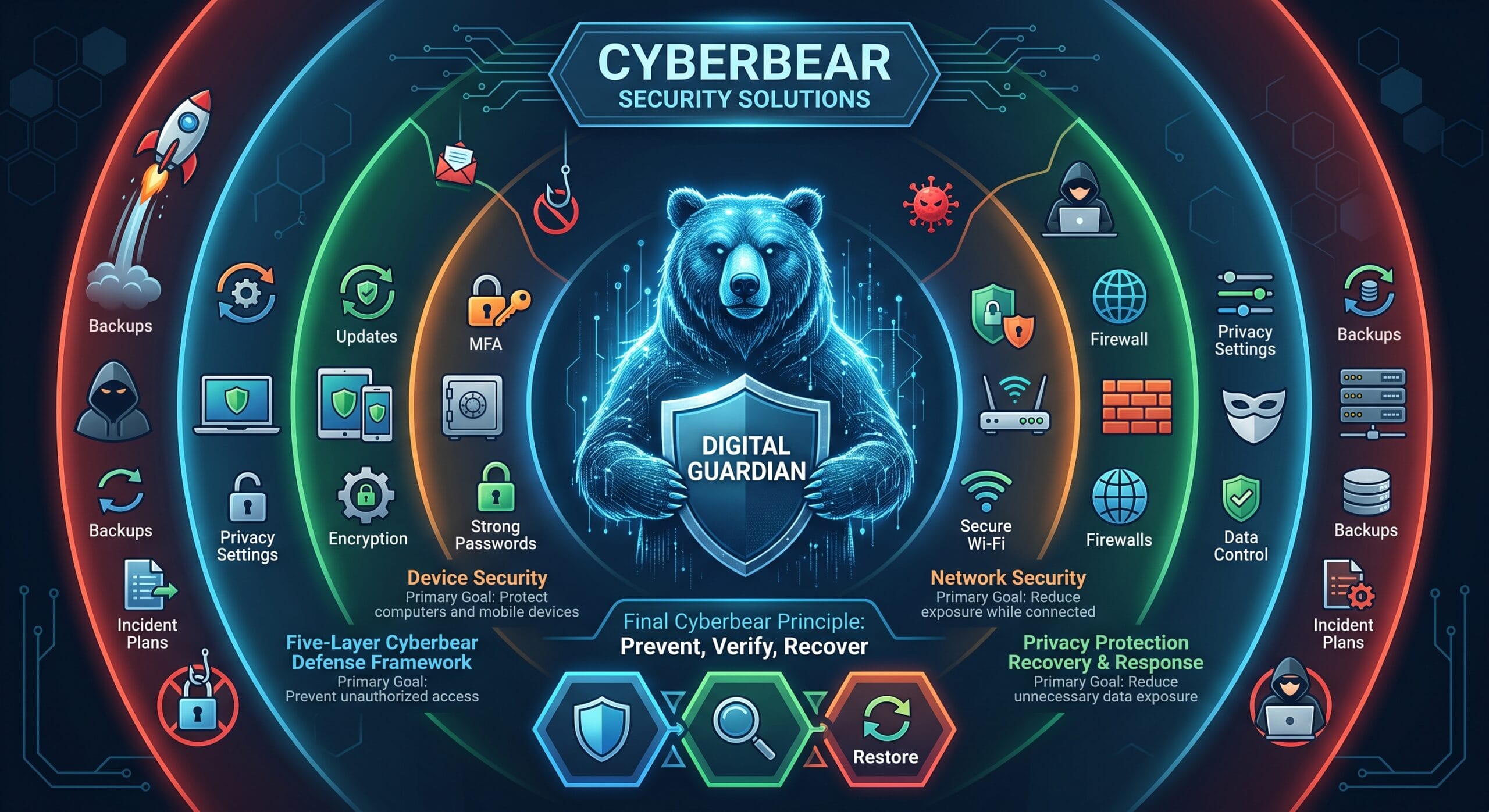
The Five-Layer Cyberbear Defense Framework
A practical way to turn the cyberbear philosophy into an actionable security model is to organize protection into five connected layers:
Layer | Primary Goal | Examples
Account Security | Prevent unauthorized access | Strong passwords, password managers, MFA
Device Security | Protect computers and mobile devices | Updates, screen locks, encryption, security software
Network Security | Reduce exposure while connected | Secure Wi-Fi, firewalls, router updates, cautious public Wi-Fi use
Privacy Protection | Reduce unnecessary data exposure | Privacy settings, tracking controls, limited public information
Recovery & Response | Limit damage after an incident | Backups, recovery codes, incident plans, account recovery procedures
The strength of this model comes from its layered design. For example, if a password is exposed through a phishing attack, MFA can provide another barrier. If malware reaches a device, endpoint protection and backups can reduce the potential impact. If an account is compromised, recovery methods can help restore control more quickly.
This defense-in-depth approach is consistent with the broader principle that cybersecurity should use multiple complementary safeguards rather than relying on a single security product. CISA similarly recommends combining strong passwords, multifactor authentication, phishing awareness, and timely software updates as core online-safety practices. (https://www.cisa.gov/secure-our-world?utm_source=chatgpt.com)
Essential Strategies for Personal Data Security
Safeguarding your personal data security is paramount in the connected world. Individuals must adopt a proactive stance to control their digital footprint and minimize exposure to risks. Learning how to stay safe online begins with understanding the value of your personal information and implementing consistent protective habits across all your online activities.
Implementing Robust Online Protection Tips
Several practical online protection tips can significantly enhance your security posture. Always use unique, complex passwords for each account, ideally generated and stored by a reputable password manager. Enable two-factor authentication (2FA) wherever possible. Regularly review privacy settings on social media and other online services, limiting the information you share publicly. Be cautious about clicking on unsolicited links or downloading attachments from unknown sources.
Proactive Cyber Threat Prevention Measures
Effective cyber threat prevention involves both technological safeguards and informed user behavior. Keep all operating systems, applications, and antivirus software updated to patch known vulnerabilities. Use a firewall to monitor and control incoming and outgoing network traffic. Back up important data regularly to an external drive or secure cloud service to mitigate the impact of ransomware or data loss. Educate yourself on common attack vectors, such as social engineering tactics.
Prioritize Your Most Important Digital Accounts
Not every online account carries the same level of risk. A strong cyberbear strategy should prioritize accounts that could provide access to other services, financial information, sensitive personal data, or account-recovery mechanisms.
Start with these high-value accounts:
- Primary email: Email accounts are often connected to password resets for other services, making them particularly important to secure.
- Banking and financial accounts: Use MFA where available and enable transaction or login alerts.
- Cloud storage: Protect accounts containing personal documents, photographs, business files, or backups.
- Social media accounts: Review recovery email addresses, phone numbers, active sessions, and connected applications.
- Shopping and payment accounts: Remove saved payment methods from services you no longer use.
- Password manager: Protect the password manager account with a strong master credential and the strongest available authentication options.
This prioritization creates a practical order of operations. If time is limited, securing the primary email, financial accounts, password manager, and cloud storage can provide substantial risk reduction before moving through less sensitive accounts.
NIST guidance also emphasizes the importance of strong, sufficiently long memorized secrets and advises against requiring arbitrary periodic password changes when there is no evidence of compromise. (https://pages.nist.gov/800-63-3/sp800-63b.html?utm_source=chatgpt.com)
Choosing the Right Tools: Antivirus and Digital Privacy
Selecting the appropriate software and tools is a cornerstone of strong digital defense. From robust antivirus programs to specialized privacy tools, these resources empower users to protect their systems and data. Understanding the options available is key to making informed decisions for your specific needs. This section will guide you through antivirus software comparison and the benefits of various digital privacy tools.
Antivirus Software Comparison: Finding Your Best Fit
When considering an antivirus software comparison, look beyond basic malware detection. Key features to evaluate include real-time scanning, ransomware protection, firewall capabilities, phishing protection, and performance impact on your system. Reputable brands often offer free trials, allowing you to assess compatibility and effectiveness. Consider independent lab test results (e.g., AV-Test, AV-Comparatives) for objective performance metrics. Your choice should align with your operating system, usage patterns, and budget.
How to Evaluate Cybersecurity Tools Before Choosing One
A trustworthy security-tool comparison should distinguish between manufacturer claims and independent evidence. Rather than choosing a product simply because it has the longest feature list, evaluate it using consistent criteria.
Evaluation Factor | What to Check
Protection | Independent malware and threat-detection results
Performance | Whether the software noticeably affects system performance
Usability | Ease of setup, alerts, configuration, and everyday use
Privacy | What information the provider collects and how it is handled
Compatibility | Supported operating systems, devices, and software
Updates | How frequently security definitions and applications are updated
Recovery Features | Ransomware recovery, quarantine, backups, or restoration capabilities
Cost | Free features, subscriptions, renewal prices, and limitations
Independent testing can provide useful evidence, but results should be interpreted in context. For example, AV-TEST evaluates security products using categories such as protection, performance, and usability, with current Windows testing based on realistic threat scenarios and current product versions. (https://www.av-test.org/en/antivirus/home-windows/?utm_source=chatgpt.com)
Readers should also check the date and platform of a test before relying on its results. A product that performs well in a particular Windows test is not automatically equivalent on macOS, Android, or another platform.
Leveraging Digital Privacy Tools for Enhanced Safety
Beyond antivirus, digital privacy tools offer additional layers of protection. A Virtual Private Network (VPN) encrypts your internet connection, masking your IP address and protecting your browsing activity from snoopers, especially on public Wi-Fi. Password managers not only generate strong, unique passwords but also securely store them, reducing the risk of credential stuffing attacks. Secure browsers with built-in tracking protection and ad blockers can further limit data collection by third parties.
Understanding the Limits of Privacy and Security Tools
Security tools are valuable, but each tool solves a specific category of problem.
A password manager can help prevent password reuse, but it cannot stop someone from voluntarily giving a password to a scammer. MFA can reduce the consequences of password theft, but some forms of authentication can still be targeted by sophisticated social-engineering attacks. A VPN can protect network traffic between the device and VPN provider, but it does not make the user completely anonymous across websites, accounts, cookies, or other tracking mechanisms.
The most reliable approach is therefore to treat privacy tools as components of a broader security system rather than as guarantees of anonymity or complete protection.
When evaluating a VPN or other privacy service, readers should examine its privacy policy, data-retention practices, jurisdiction, technical features, and independent security assessments where available. Avoid selecting a service solely because it advertises itself as offering “complete anonymity.”
Recognizing and Avoiding Common Online Dangers
Even with the best tools, human vigilance remains crucial. Understanding how common online dangers manifest is essential for effective self-protection. This includes learning phishing scam identification and ensuring internet safety for families.
Phishing Scam Identification Techniques
Phishing scam identification relies on recognizing red flags in emails, messages, or websites. Common indicators include urgent or threatening language, requests for personal information, generic greetings instead of your name, grammatical errors, and suspicious sender email addresses or URLs that don’t match the purported sender. Always verify the legitimacy of a request through an official channel (e.g., calling the company directly using a number from their official website) rather than replying to the suspicious communication.
Modern Phishing Goes Beyond Suspicious Emails
Phishing is no longer limited to poorly written emails. Attackers can use convincing branding, compromised accounts, realistic websites, text messages, social-media messages, and other communication channels to make fraudulent requests appear legitimate.
A stronger verification process is to stop the interaction and independently confirm the request. Instead of clicking the supplied link, open the organization’s official website manually or use a trusted application. Instead of replying to a suspicious message, contact the person or organization through a previously known communication method.
Pay particular attention when a message asks you to:
– Reveal a password, verification code, or recovery code.
– Move money or purchase gift cards.
– Approve an unexpected login or MFA request.
– Open an unexpected attachment.
– Install unfamiliar software.
– Bypass a normal company or family procedure.
– Provide identity or financial information under time pressure.
CISA identifies phishing, strong passwords, MFA, and software updates as core actions for reducing everyday online risk. (https://www.cisa.gov/secure-our-world?utm_source=chatgpt.com)
Internet Safety for Families: Protecting All Ages
Ensuring internet safety for families requires open communication and setting clear boundaries. Educate children about the risks of sharing personal information online, interacting with strangers, and the permanence of digital content. Utilize parental control software and privacy settings on devices and platforms. Encourage critical thinking about online content and foster an environment where family members feel comfortable reporting anything suspicious or uncomfortable they encounter online. Regular discussions about online behavior are vital.
Social Engineering: The Human Side of Cybersecurity
Technical defenses can be weakened when an attacker successfully manipulates a person. Social engineering describes attacks that exploit trust, urgency, fear, curiosity, authority, or other human factors to persuade someone to reveal information or perform an action.
Common examples include:
– Impersonating a bank employee or technical-support representative.
– Pretending to be a manager or family member.
– Creating an urgent payment request.
– Claiming that an account will be closed unless the recipient acts immediately.
– Sending a fake delivery, invoice, tax, or account-security notification.
– Asking for a one-time verification code.
The best defense is not simply memorizing every scam. Establish verification habits that remain useful even when the attack changes. For high-risk requests, independently verify the person’s identity and use a second communication channel when appropriate.
Families can also create a simple rule: no one should be embarrassed or punished for reporting a suspicious message quickly. This encourages early reporting and can reduce the time between an attempted attack and corrective action.
What to Do If You Suspect an Account or Device Has Been Compromised
A cyberbear strategy should include recovery, not just prevention. If an account or device appears compromised, acting quickly can limit further damage.
Immediate Account-Compromise Steps
- Use a trusted device when possible to access the affected account.
- Change the compromised password and any other accounts that reused it.
- Enable or strengthen MFA if it is available.
- Review active sessions and logged-in devices and remove unfamiliar sessions.
- Check account recovery information for unauthorized email addresses or phone numbers.
- Review recent account activity for suspicious messages, purchases, transfers, or changes.
- Contact the relevant service provider through its official support channel if access has been lost.
- Preserve evidence such as suspicious messages, transaction records, or login notifications when appropriate.
If Ransomware Is Suspected
If ransomware is actively affecting a device or network, avoid treating the situation as a normal software problem. Isolating affected systems can help prevent further spread, while clean and properly maintained backups can support recovery. CISA recommends maintaining offline, encrypted backups and regularly testing backup availability and restoration procedures. (https://www.cisa.gov/stopransomware/ransomware-guide?utm_source=chatgpt.com)
For organizations or serious incidents, professional incident-response assistance may be appropriate. The exact response should depend on the affected systems, the type of information involved, and the potential consequences of the incident.
Cyberbear Security Checklist for Everyday Users
- Use a unique password for every important account.
- Use a reputable password manager where appropriate.
- Enable MFA on email, financial, cloud, social-media, and other important accounts.
- Keep operating systems, browsers, applications, and security software updated.
- Review account recovery email addresses and phone numbers.
- Remove old devices and unfamiliar sessions from important accounts.
- Review privacy settings on frequently used services.
- Avoid entering sensitive information after following an unexpected link.
- Maintain backups of important files.
- Keep at least one important backup protected from ransomware-related encryption or deletion.
- Secure your home Wi-Fi router and change default administrative credentials.
- Be cautious with public Wi-Fi and unfamiliar USB devices.
- Teach children and other family members how to report suspicious activity.
- Know how to recover your most important accounts before an emergency occurs.
CISA’s consumer-focused guidance similarly emphasizes recognizing and reporting phishing, using strong passwords, enabling MFA, and updating software as foundational security habits. (https://www.cisa.gov/secure-our-world?utm_source=chatgpt.com)
Frequently Asked Questions About Cyberbear and Online Security
Q: What exactly does “cyberbear” mean in practice?
A: A cyberbear represents a comprehensive, proactive approach to digital defense. It means integrating strong technical safeguards, informed user behavior, and continuous education to protect your online presence from various threats.
Q: What are the most important steps for individuals on how to stay safe online?
A: Key steps include using strong, unique passwords with 2FA, keeping software updated, being wary of suspicious links, backing up data, and understanding privacy settings.
Q: Is antivirus software still necessary with modern operating system defenses?
A: Yes, while operating systems have improved, dedicated antivirus software provides an additional, specialized layer of protection against a wider range of evolving threats, including zero-day exploits and sophisticated malware.
Q: How often should I change my passwords?
A: Instead of frequent changes, focus on using strong, unique passwords for each account, ideally managed by a password manager. If a service reports a breach, change that specific password immediately.
Q: Can a VPN make me completely anonymous online?
A: A VPN significantly enhances your privacy by encrypting your connection and masking your IP address, but it does not guarantee complete anonymity. Other factors, like browser cookies and online accounts, can still identify you.
Q: What should I do if I accidentally click a phishing link?
A: Do not panic. Stop interacting with the suspicious page or message, avoid entering additional information, and close the page if appropriate. If you entered a password, change it from a trusted device and enable MFA if available. If financial information was submitted, contact the relevant financial institution through its official channel. Monitor the affected account for unusual activity and preserve the suspicious message if it may be useful for reporting or investigation.
Q: Is a password manager enough to protect my accounts?
A: A password manager is an important security control because it can help users create and maintain unique credentials, but it is not a complete security system. Strong account recovery options, MFA, updated devices, phishing awareness, and secure account practices remain important.
Q: Are public Wi-Fi networks always unsafe?
A: Public Wi-Fi should be treated as an environment where additional caution is appropriate rather than automatically assuming that every network is malicious. Avoid sensitive activities on networks you do not trust when possible, use encrypted connections, keep devices updated, and verify that websites and applications are using secure connections.
Q: How often should I test my backups?
A: Backups should not simply exist; important backups should be checked periodically and restoration procedures should be tested. CISA specifically recommends maintaining offline, encrypted backups and regularly testing their availability and integrity. (https://www.cisa.gov/stopransomware/ransomware-guide?utm_source=chatgpt.com)
Q: What is the biggest weakness in a cybersecurity strategy?
A: A single point of failure can become a major weakness. Relying entirely on one password, one security application, one backup, or one person’s knowledge creates unnecessary risk. A layered cyberbear strategy distributes protection across prevention, detection, privacy, and recovery.
Authoritative Cybersecurity Resources for Further Verification
Because cybersecurity recommendations can change as threats and technologies evolve, readers should verify important security guidance against reputable primary or independent sources.
- CISA Secure Our World: Provides practical guidance covering phishing, passwords, MFA, software updates, and family online safety. (https://www.cisa.gov/secure-our-world?utm_source=chatgpt.com)
- NIST Digital Identity Guidelines: Provides technical guidance on authentication and password management. (https://pages.nist.gov/800-63-3/sp800-63b.html?utm_source=chatgpt.com)
- CISA #StopRansomware: Provides ransomware prevention, backup, and recovery guidance. (https://www.cisa.gov/stopransomware/ransomware-guide?utm_source=chatgpt.com)
- AV-TEST: Provides independent security-product testing covering protection, performance, and usability. (https://www.av-test.org/en/antivirus/home-windows/?utm_source=chatgpt.com)
When citing security products, statistics, standards, or recommendations, prefer the original organization, standard-setting body, government agency, or independent testing laboratory over an unsourced secondary claim.
Conclusion: Fortifying Your Digital Presence with Cyberbear
Establishing a robust digital defense is no longer optional; it is a fundamental aspect of modern life. By embracing the principles of a cyberbear, individuals and families can build a resilient shield against the myriad of online threats. This involves a multi-layered approach, combining advanced cyberbear security solutions with informed user practices and the strategic use of online protection tips. Continuous vigilance, education, and the adoption of appropriate tools are essential to maintaining a secure and private digital presence. Fortify your digital life by becoming your own cyberbear.
Final Cyberbear Principle: Prevent, Verify, Recover
The most effective digital defense is not based on finding one perfect security tool. It is based on building habits that make attacks more difficult, recognizing suspicious activity before it becomes a serious problem, and maintaining reliable recovery options when prevention fails.
Think of your cyberbear strategy as three connected responsibilities:
Prevent by securing accounts, devices, networks, and personal information.
Verify by questioning unexpected requests, suspicious links, unfamiliar login alerts, and unusual account activity.
Recover by maintaining backups, recovery methods, updated contact information, and a clear plan for responding to compromised accounts or devices.
This approach makes the cyberbear concept practical: strong enough to reduce everyday risks, flexible enough to adapt to new threats, and realistic enough to acknowledge that no digital environment can be made completely risk-free.
Must be read:https://authoritiesvista.tech/cloud-native-security-practices/
[…] The integration of AI into the workplace is an ongoing transformation, not an endpoint. Understanding what jobs are safe from AI involves recognizing and cultivating uniquely human capabilities. Professions that demand creativity, emotional intelligence, complex strategic thinking, and direct human interaction are poised for longevity. By focusing on developing these distinctively human skills, individuals can secure their place and thrive in the evolving professional landscape, building truly future proof careers. Must be read:https://authoritiesvista.tech/cyberbear-digital-protection/ […]