
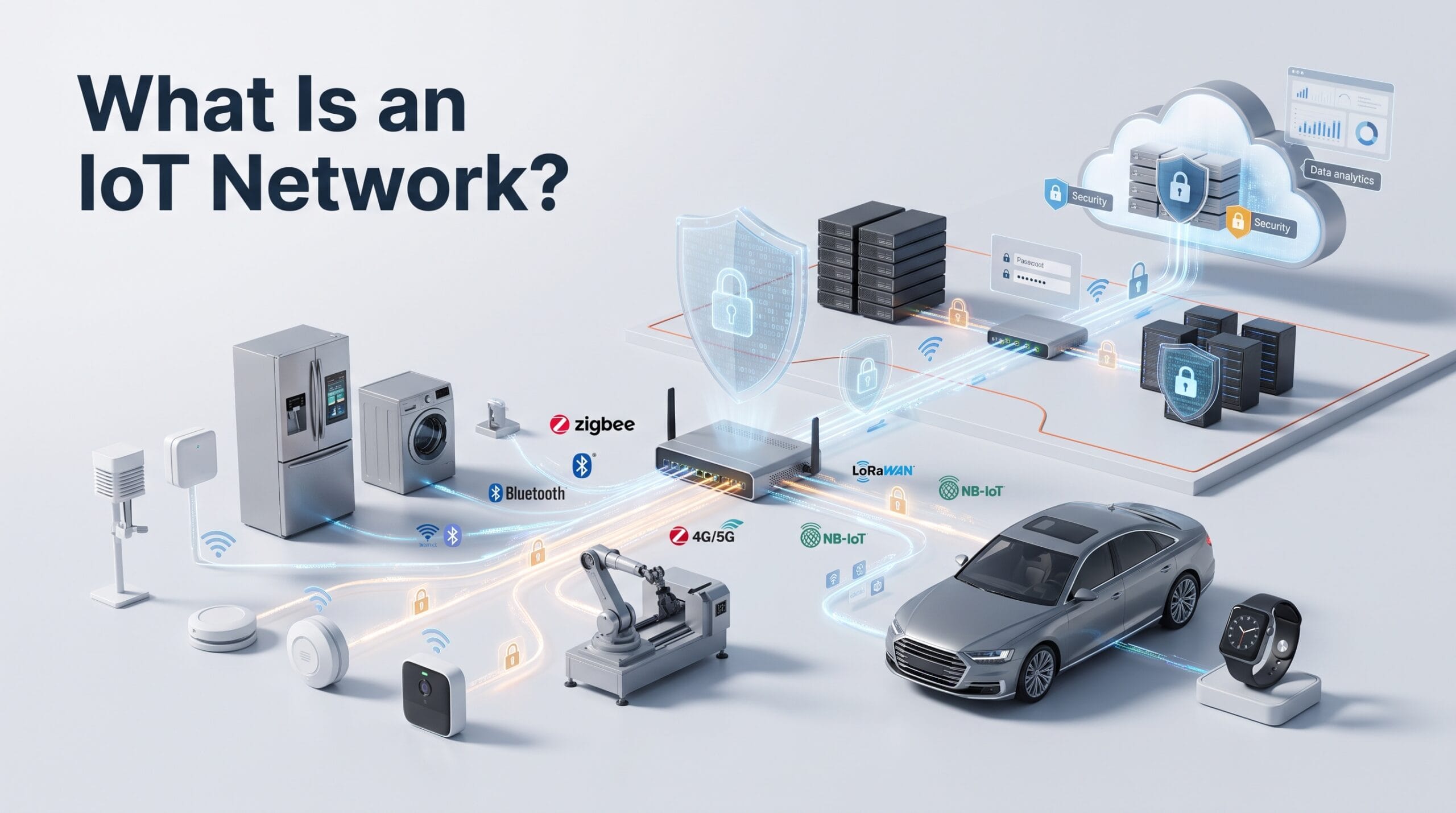
An Internet of Things (IoT) network represents a foundational infrastructure that connects physical devices, vehicles, home appliances, and other items embedded with sensors, software, and other technologies. This connectivity enables these objects to connect and exchange data over the internet. The fundamental purpose of an IoT network is to facilitate seamless communication between these devices, allowing for data collection, remote monitoring, and automated control, thereby bridging the gap between the physical and digital worlds. Its growing relevance stems from its ability to generate actionable insights from real-world data, driving efficiency, convenience, and innovation across various sectors. This article explores what an IoT network is, its core components, how it functions, and the critical security considerations involved.
IoT Network Architecture at a Glance
An IoT network can be understood as a layered system rather than simply a collection of connected devices. At the device or edge layer, sensors and actuators interact with the physical environment. Connectivity technologies then transport data between devices, gateways, and backend systems. Gateways or edge computing systems can aggregate and process data locally, while cloud or on-premises platforms provide storage, analytics, device management, and application services.
Physical environment → IoT device/sensor → Connectivity network → Gateway/edge → IoT platform → Application → User or automated action
Not every IoT deployment uses a separate gateway or a public cloud. Some systems process data directly at the edge, while others use on-premises servers or a combination of edge and cloud infrastructure. The appropriate architecture depends on requirements such as latency, connectivity availability, data volume, privacy, reliability, and operational cost.
How IoT Networks Function
Understanding how IoT networks work involves recognizing a multi-stage process that transforms raw environmental data into actionable intelligence. The operational flow typically begins with data collection. IoT devices and sensors gather specific data points from their surroundings, such as temperature, humidity, motion, or location. This data is then transmitted through various connectivity technologies to an IoT gateway function. The gateway often performs initial data processing, filtering, and protocol translation before forwarding the data to cloud platforms. Once in the cloud, advanced analytics and machine learning algorithms process the data, identify patterns, and generate insights. These insights can then trigger automated actions, send alerts, or be presented to users through applications, completing the end-to-end communication process that defines an effective IoT network.
What Happens When an IoT Device Goes Offline?
A reliable IoT network should account for temporary connectivity failures rather than assuming that every device will remain continuously connected. Depending on the application, an IoT device may temporarily store measurements locally, retry transmission, use an alternative communication path, or continue performing predefined local actions until connectivity is restored.
For critical deployments, engineers should also consider what happens when a gateway, network connection, cloud service, or individual sensor fails. This makes fault tolerance, monitoring, buffering, retry policies, and recovery procedures important parts of IoT network design.
Core Components of an IoT Network
A functional IoT network relies on several essential building blocks working in concert to achieve its objectives. These components ensure data flows smoothly from the physical world to digital applications and back.
IoT Devices and Sensors
At the edge of any IoT network are the IoT devices and sensors. These are the physical objects equipped with the capability to collect data from their environment. Sensors detect specific physical parameters (e.g., light, sound, pressure, temperature, motion), while actuators can perform actions based on received commands (e.g., turning lights on/off, adjusting thermostats). Common IoT devices explained include smart thermostats, wearable fitness trackers, industrial machinery sensors, and smart city cameras. These devices are often designed for low power consumption and specific functions, making them integral to data acquisition.
IoT Gateways
An IoT gateway function is crucial as it acts as an intermediary between the diverse IoT devices and the cloud. Devices often use various short-range communication protocols that are not directly internet-compatible. The gateway aggregates data from multiple devices, translates different communication protocols into a standard internet protocol (like TCP/IP), and securely transmits the data to the cloud. Beyond protocol translation, gateways can also perform edge computing, processing data locally to reduce latency, conserve bandwidth, and enhance security before sending only relevant information to the cloud.
Cloud Platforms and Analytics
The cloud infrastructure forms the backbone for data storage, processing, and analysis within an IoT network. Once data reaches the cloud via the gateway, it is stored in scalable databases. Cloud platforms provide the computational power and tools necessary for advanced analytics, machine learning, and artificial intelligence. These capabilities transform raw data into meaningful insights, enabling predictive maintenance, operational optimization, and new service development. Applications hosted on these platforms allow users to monitor devices, visualize data, and control IoT systems remotely.
IoT Connectivity Technologies
The ability of devices to communicate is central to what is IoT connectivity. Various communication protocols and standards facilitate data exchange within an IoT network, collectively known as IoT connectivity technologies or iot connectivity types. The choice of technology depends on factors like range, power consumption, data rate, and cost.
Short-Range Wireless Technologies (e.g., Bluetooth, Wi-Fi, Zigbee)
Bluetooth: Ideal for short-distance, low-power personal area networks, often used in wearables, smart home devices, and asset tracking within a limited area.
Wi-Fi: Provides high-bandwidth connectivity over medium distances, suitable for devices requiring frequent data transfer, such as smart cameras or streaming devices within homes or offices.
Zigbee: A low-power, low-data-rate mesh network protocol often used in smart home automation (e.g., lighting, thermostats) due to its reliability and ability to extend range through device-to-device communication.
Long-Range Wireless Technologies (e.g., Cellular, LoRaWAN, NB-IoT)
Cellular (4G/5G): Offers wide-area coverage and high data rates, suitable for applications requiring mobility and substantial data transfer, such as connected vehicles or remote monitoring in large geographical areas.
LoRaWAN (Long Range Wide Area Network): Designed for low-power, long-range communication, making it suitable for applications like smart agriculture, smart cities (e.g., waste management), and asset tracking where devices send small packets of data infrequently over several kilometers.
NB-IoT (Narrowband IoT): A low-power wide-area (LPWA) technology optimized for low-cost, low-power devices requiring long battery life and deep indoor penetration, often used for smart metering and utility monitoring.
Types of IoT Networks
IoT networks can be categorized based on their scale, purpose, and architectural design, each serving distinct applications and industries. Understanding these types of IoT networks helps in appreciating their diverse impact.
Consumer IoT Networks
Consumer IoT networks primarily focus on enhancing convenience, comfort, and entertainment in personal environments. The smart home IoT network is a prime example, integrating devices like smart lighting, thermostats, security cameras, voice assistants, and smart appliances. These networks allow individuals to control and automate aspects of their homes remotely, often through a central hub or smartphone application.
Industrial IoT (IIoT) Networks
The industrial IoT network (IIoT) applies IoT principles to industrial settings, including manufacturing, energy, logistics, and agriculture. IIoT networks connect sensors on machinery, production lines, and infrastructure to monitor performance, predict maintenance needs, optimize operational efficiency, and enhance safety. Examples include smart factories with automated quality control, remote monitoring of oil pipelines, and precision agriculture systems.
Commercial and Enterprise IoT Networks
These networks encompass a broad range of applications beyond consumer and heavy industry. They include IoT solutions for retail (e.g., inventory management, customer analytics), healthcare (e.g., patient monitoring, asset tracking), smart buildings (e.g., energy management, occupancy sensing), and logistics (e.g., fleet management, supply chain optimization). Their goal is typically to improve business processes, reduce costs, and create new services.
Real-World IoT Network Examples
To illustrate the practical impact, here are some real-world IoT network examples that demonstrate the versatility and utility of connected systems across various sectors. These examples of IoT networks highlight how data collection and automation drive tangible benefits.
Smart Home Automation
A common example is a smart home where devices like connected thermostats (e.g., Nest), smart lighting systems (e.g., Philips Hue), and security cameras (e.g., Ring) form an interconnected network. These devices communicate to adjust climate based on occupancy, turn lights on/off according to schedules or motion, and provide real-time security monitoring, all controllable via a smartphone app or voice commands.
Smart City Infrastructure
Cities leverage IoT networks for improved urban management. Examples include smart streetlights that adjust brightness based on ambient light or traffic, smart waste bins that signal when they need emptying, and traffic management systems that optimize signal timing to reduce congestion. These systems rely on a network of sensors and communication infrastructure to collect data and enable responsive urban services.
Connected Healthcare
In healthcare, IoT networks facilitate remote patient monitoring through wearable devices that track vital signs, glucose levels, or activity. Hospitals use IoT for asset tracking, locating medical equipment quickly, and monitoring environmental conditions in sensitive areas. These applications enhance patient care, improve operational efficiency, and provide critical data for medical professionals.
Addressing IoT Network Security Challenges
While IoT networks offer significant advantages, they also introduce complex IoT network security challenges. The sheer number and diversity of connected devices, often with limited processing power, create numerous potential vulnerabilities. Robust IoT network security is paramount to protect data, privacy, and operational integrity.
Device-Level Security
Securing individual IoT devices is the first line of defense. This involves implementing secure boot processes to ensure only trusted software runs, providing regular firmware updates to patch vulnerabilities, and enforcing strong authentication mechanisms (e.g., unique passwords, multi-factor authentication) to prevent unauthorized access to devices themselves. Many IoT devices and sensors are deployed with default, weak credentials, making them easy targets.
Data Privacy and Integrity
Protecting the data collected and transmitted by IoT networks is critical. This requires end-to-end encryption for data both in transit and at rest, strict access control policies to limit who can view or modify data, and adherence to data privacy regulations (e.g., GDPR, CCPA). Ensuring data integrity means preventing unauthorized alteration of data, which could lead to incorrect decisions or system malfunctions.
Network Vulnerabilities
The communication channels and network infrastructure itself are susceptible to attacks. Securing these involves using robust network segmentation, intrusion detection systems, and firewalls. Regular security audits and penetration testing are essential to identify and mitigate vulnerabilities that could allow unauthorized access, denial-of-service attacks, or data interception within the IoT network.
Frequently Asked Questions About IoT Networks
What is the primary purpose of an IoT network?
The primary purpose of an IoT network is to connect physical devices to the internet, enabling them to collect and exchange data for monitoring, control, and automation. This facilitates the creation of smart environments and efficient operations.
How do IoT devices communicate within a network?
IoT devices communicate within a network through various IoT connectivity technologies such such as Wi-Fi, Bluetooth, cellular (4G/5G), LoRaWAN, and Zigbee. This communication is often facilitated by an IoT gateway function, which translates protocols and manages data flow to the cloud.
What are the main components required for an IoT network?
The main components of an IoT network include IoT devices and sensors for data collection, IoT gateways for data aggregation and protocol translation, various connectivity infrastructure, and cloud platforms for data processing, storage, and application hosting.
What are some common security concerns for IoT networks?
Common IoT network security challenges include insecure devices with weak authentication, potential data privacy breaches, unauthorized access to network infrastructure, and vulnerabilities in communication protocols that could be exploited for attacks.
Expert Takeaway: Designing an IoT Network for Long-Term Success
A successful IoT network should be evaluated as a complete system rather than as a collection of individual connected devices. The strongest deployments align the device capabilities, connectivity technology, network architecture, data-processing strategy, security controls, and lifecycle management with the actual business or operational requirement.
Before selecting an IoT solution, decision-makers should ask:
What data needs to be collected?
How frequently does it need to be collected?
How quickly must the system respond?
What happens if connectivity is interrupted?
How long must devices operate?
How will devices receive security updates?
How will the organization monitor thousands of devices?
What happens when devices reach the end of their useful life?
Can the architecture scale without creating unacceptable operational or security risks?
Taking these questions into account early can make an IoT network more reliable, maintainable, secure, and cost-effective over its operational lifecycle.
Conclusion
Answering what is an IoT network reveals a complex yet powerful ecosystem of interconnected physical devices, sensors, gateways, and cloud platforms. These networks are designed to collect, transmit, process, and act upon data from the physical world, driving automation and intelligence. From enhancing daily life in a smart home to optimizing industrial processes and transforming urban infrastructure, the applications are vast. The benefits of IoT networks are clear, offering unprecedented levels of efficiency, insight, and convenience. However, realizing these benefits requires careful attention to the architecture, choice of IoT connectivity technologies, and, critically, robust security measures to protect against the inherent IoT network security challenges. As the number of connected devices continues to grow, understanding and securing these intricate networks will remain a top priority for innovation and reliable operation.
Must be read:https://authoritiesvista.tech/generative-ai-data-challenges/