
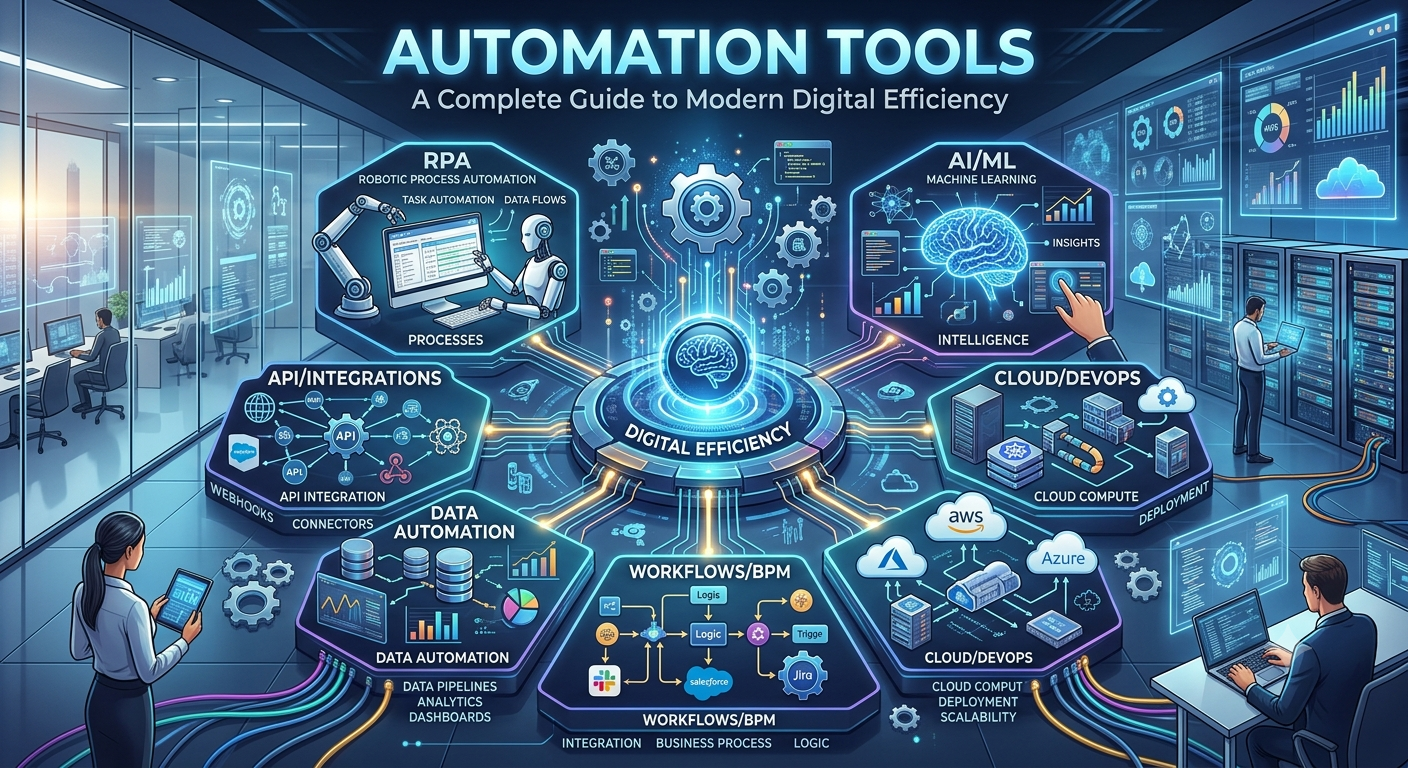
Introduction to Automation Tools
In the fast-growing digital age, automation tools are now essential for businesses as well as developers and marketers as well as freelancers. They help to reduce the manual effort, cut down on time, and increase the efficiency by handling repetitive tasks in a way that is automated.
It doesn’t matter if it’s the case of email marketing, data entry software testing, or even customer assistance; automation tools have revolutionised the way that modern-day work is carried out. Instead of being occupied with routine tasks, workers can now concentrate on creativity and strategy as well as decision-making.
This article provides all the information concerning automated tools, including their purpose, kinds, and benefits as well as real-world applications. the most effective tools to be used in 2026.
What Are Automation Tools
Tools for automation are programs that have been created to complete tasks automatically with no human involvement. They adhere to predefined rules or utilise artificial intelligence to perform workflows in a timely manner.
For instance,
Automated emailing
The scheduling of social media posts
Testing software in the course of running
Controlling business workflows
They reduce manual work and improve productivity. Businesses are increasingly relying on automation in order to remain competitive in the modern economy.
Automation Software Definition, Examples, and Applications
Automation software could be described as software systems that perform repetitive tasks in a controlled manner by relying on rules, triggers, and AI-powered decision-making.
Common examples include:
Zippier (workflow automation)
Airpath (robotic automated process)
Selenium (test automation)
HubSpot (marketing automation)
Why Automation Tools Are Important in 2026
The need for tools for automation has been growing rapidly since 2026 as a result of AI Integration and digital transformation. Companies handle huge volumes of data and require speedier, more accurate systems.
Important reasons to be important:
Reduces human workload
Increases the efficiency of businesses
Minimizes errors
Reduces the cost of operation
Enhances customer experience
Modern businesses are unable to scale efficiently without some kind of automation.
Types of Automation Tools
1. Business Workflow Automation Tools
These tools can automate internal business processes like the approval process, reporting and assigning tasks.
Examples:
Zippier
Make (Integrate)
Monday.com automation features
2. Marketing Automation Software
Marketing teams utilise automation software to handle emails as well as social media. customer interaction.
Examples:
HubSpot
Mailchimp
Active Campaign
These tools enable businesses to communicate with their customers at the right moment by sending customised messages.
3. AI Workflow Automation Tools
One of the fastest-growing areas is automation powered by AI. The tools employ machine learning algorithms to make choices and improve workflows.
This is directly connected to the subject:
10 Best AI Workflow Automation Tools I’m using it in 2026
Some of the most popular tools are:
Notion AI
Automation Tools: A Complete Guide to Modern Digital Efficiency
AI
Click Up AI
Jasper AI workflows
Open-air API automation systems
These tools can be used to automate difficult tasks such as the creation of content as well as data analysis and also decision-making.
4. Software Testing Automation Tools
Developers utilise the tools for testing their apps in a controlled manner.
This is related to:
12 Best AI Test Automation Tools for 2026 – The Third Wave
Examples include:
Selenium
Cypress
Test Complete
Katalin Studio
Playwright
They assure the quality of software and cut down on manual testing.
5. IT and Robotic Process Automation (RPA) Tools
RPA tools mimic human actions within digital platforms.
Examples:
Airpath
Automation Anywhere
Blue Prism
These tools are extensively used in healthcare, banking, and corporate systems.
How Automation Tools Work
Automation tools operate by following a simple procedure:
Trigger – When an event occurs, it initiates this process (e.g., the receipt of an email)
Conditions – Rules dictate the next step
Intervention – A system executes the task on its own.
Certain advanced tools also employ AI to make better decision-making over time.
Benefits of Using Automation Tools
Individuals and businesses gain a variety of benefits by making use of automated tools:
Increased Productivity
Tasks are completed quicker with no manual effort.
Cost Efficiency
Businesses can save money by reducing their workforce’s dependence on routine tasks.
Accuracy and Reliability
Automation reduces human error when handling data and other operations.
Time Saving
Employees can concentrate on innovative or strategic projects.
Scalability
Businesses can expand faster without putting more people through the same process.
Challenges of Automation Tools
While automated tools are effective, however, they are not without problems:
High cost of setting up for sophisticated systems
A learning curve for novices
Dependence on software systems
The need for regularly scheduled updates, maintenance and upgrades
However, these problems outweigh the benefits in the long run.
Best Practices for Using Automation Tools
To make the most from automated tools Follow these guidelines:
Begin with a simple workflow
Pick the tools that best suit your the business requirements
Beware of over-automation
Check performance on a regular basis
Combine AI and human supervision
Future of Automation Tools
Automating the future will be linked to AI as well as machine learning. In the years ahead, automation software will be more intelligent and adaptive. They will also be self-learning.
We can anticipate:
Fully AI-driven workflows
Smarter decision-making systems
No-code automation platforms
Real-time predictive automation
Automation is expected to continue to change industries such as healthcare, marketing and finance as well as software development.
Conclusion
Tools for automation have become no longer a luxury; they are essential in the digital age. From small-scale businesses to big companies, everyone is utilising automation to boost efficiency and decrease workload.
As technology continues to advance, automation software will get more sophisticated and efficient, which will make work quicker and easier. They will also be more precise.
Knowing and using these tools today will provide businesses with a competitive advantage in the next digital economy.