
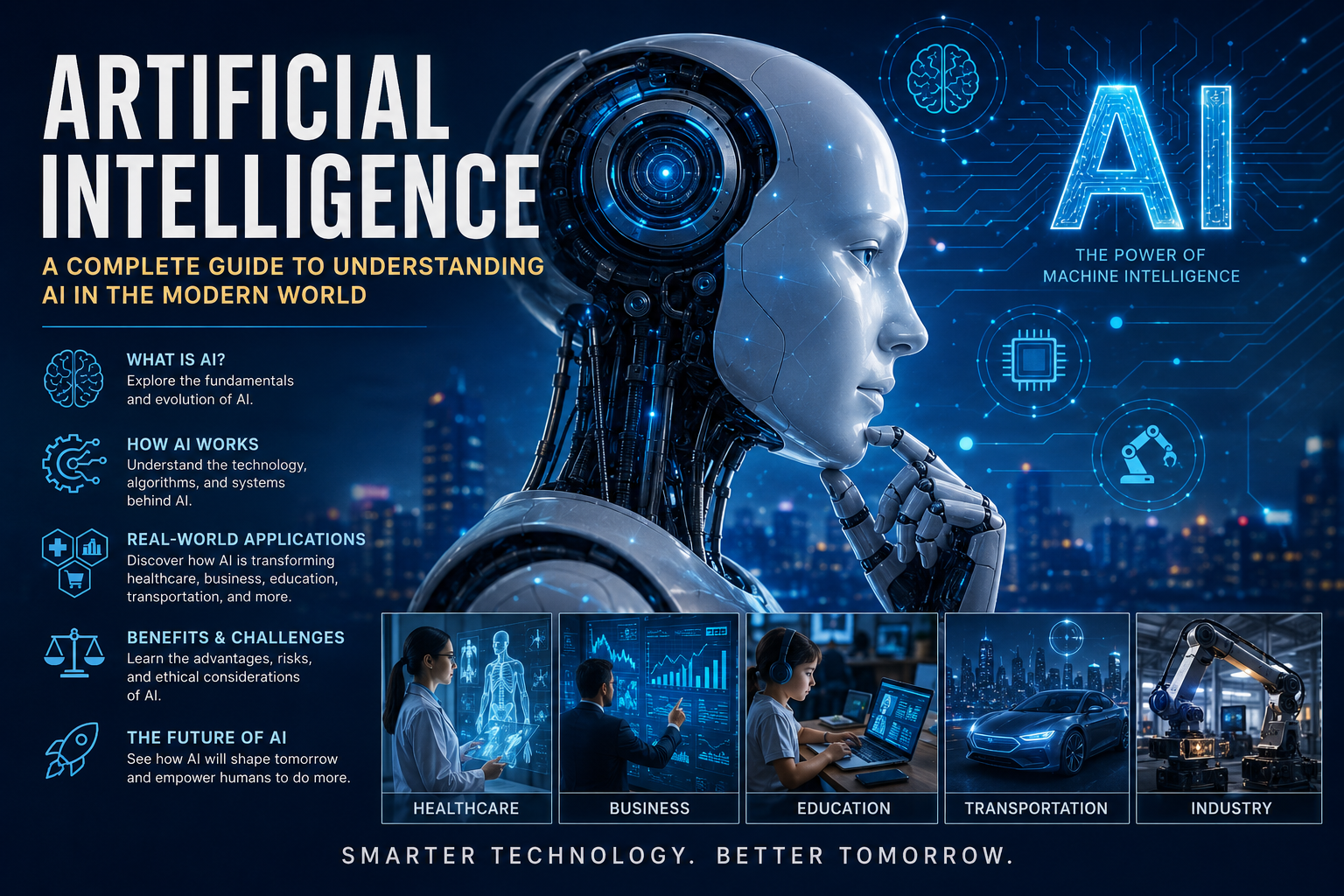
Introduction
Artificial Intelligence is one of the most innovative and disruptive technologies currently in use. Starting with smartphones or search engines financial platforms, and health systems Artificial Intelligence is shaping the way that humans interact with computers and data. It enables computers as well as other electronic devices to perform tasks that require human insight to make decisions, reasoning as well as problem-solving and making decisions.
In this digital age, Artificial Intelligence is no only confined to research labs and big tech companies. It’s now a part of everyday life and has a profound impact on education, business as well as transportation, healthcare as well as entertainment. This article provides a thorough, explanation of Artificial Intelligence using the Yoast SEO best practices, while preserving the natural use of keywords without over-extending them.
Artificial Intelligence
Artificial Intelligence (AI) is the ability of computers or software to replicate humans’ intelligence. AI systems are built to analyze data, detect patterns, interpret events, and make choices that do not require human intervention.
Based on the best research and educational organizations, Artificial Intelligence involves creating algorithms and models that allow machines to behave and think effectively. Institutions like EDUCAUSE or NIST have established Machine intelligence as an expansive field that encompasses machine learning and natural computer vision and language processing and automated intelligent systems.
In basic form, Machine intelligence focuses on creating machines that are more intelligent and adaptive, capable of improving performance over the process over time.
The Evolution and History of Artificial Intelligence
The idea behind Artificial Intelligence dates back to the middle of the 20th century, when researchers began investigating the possibility of machines mimicking human thinking. In the beginning, AI systems were based on rules, and were only limited in their capabilities and heavily relying upon established logic.
With time technological advances with processing speed, accessibility of data and the development of algorithms have led to significant advancements in Machine intelligence. Machine learning has enabled machines to gain information from their data instead of following strict guidelines. Nowadays the use of neural networks as well as deep learning has brought Machine intelligence to new levels in accuracy and efficiency.
This transformation has transformed Machine intelligence into a practical and scalable solution for all sectors, instead of being a concept that is abstract.
W Types of Artificial Intelligence
Narrow Machine intelligence
Narrow Machine intelligence, also known as”weak” AI was designed in order to perform specific functions. Some examples include voice and recommendation systems, as well facial recognition software. The majority of Artificial Intelligence applications in use currently fall into this category.
General Machine intelligence
General Machine intelligence is the term used to refer to machines capable of performing every task of intelligence that humans are capable of performing. This kind of Artificial Intelligence remains theoretical and is the most important area of study.
Super Artificial Intelligence
Super Artificial Intelligence describes a future scenario in which computers can outdo humans in all ways. Although it is subject to debate, this concept shows the potential for the future as well as the ethical consequences for Machine intelligence development.
How Artificial Intelligence Works
Artificial Intelligence is a process of mixing massive quantities of data using advanced techniques. The algorithms look for patterns, identify patterns and improve their accuracy through constant learning.
Machine learning has become a crucial component of Machine intelligence, allowing systems to learn without needing written codes. Deep learning is one of the components of machine learning, employs multiple neural networks that process complex data such as images, audio or text.
Utilizing these techniques, Machine intelligence systems can automate processes, enhance the process of making decisions and offer personalized experiences.
Applications of Artificial Intelligence in Real Life
Artificial Intelligence has been utilized extensively in a variety of industries:
Health AI helps in detection of illness as well as medical imaging and personalized medical plans.
Educational Smart Technology that can be used for learning and tutoring and also adaptive platforms that improve the performance for students.
Finance Machine intelligence enhances the detection of fraud, risk analysis and streamlines trading.
Business AI-powered tools can improve marketing customer service, management and the overall efficiency of supply chain.
Transportation: Autonomous driving technologies as well as traffic optimization heavily depend on Machine intelligence.
These applications demonstrate the ways that Machine intelligence improves efficiency, effectiveness, and even innovation.
Benefits of Artificial Intelligence
Artificial Intelligence provides a myriad of benefits that make it a vital component of today’s systems:
Automatization and productivity enhancements
More precise and speedier evaluation of information
Improved customer experience
Human error is reduced
Affordable and scalable solutions that are affordable and scalable.
When used correctly, Machine intelligence helps organizations make better choices and give more value to their customers.
Challenges and Risks of Artificial Intelligence
Despite its many advantages, Artificial Intelligence also presents challenges. Privacy of algorithms for data and bias in algorithms and displacement of jobs are the main issues. If not created in a way that is properly designed, AI systems could increase inequalities, or cause poor decisions.
Transparency ethics, ethical development and regulations are vital to ensure your Machine intelligence is used in responsibly. Governments and organizations must work together in order to ensure that innovation is accompanied by accountability.
The Role of Machine intelligence in the Future
What’s next for HTML0 Machine intelligence is closely tied to sustainability, innovation, and human-to-human interaction. As AI technology improves, it will assist in the creation of smarter cities, better access to healthcare and personalized education.
While not replacing human beings Machine intelligence is believed to enhance human capabilities which will allow individuals to concentrate on creativity and the ability to think strategically and solve problems.
Conclusion
Artificial Intelligence doesn’t merely a trend in technology, but an essential force that will determine how we live in the near future. From enhancing accessibility to everyday use to solving problems across the globe Machine intelligence continues to revolutionize how machines function.
Once they know how Machine intelligence works, its advantages and drawbacks, both business and individuals can make educated decisions and prepare for an AI-driven future. When it is developed ethically and ethically, Machine intelligence has the potential to create an improved, more efficient and a more inclusive society.
Must Read: https://authoritiesvista.tech/best-tool-brand-guide-quality-performance-trust/